
Monsters and Angels, along with the first two book in the Connor Rix series, received a nice notice over at superheronovels.com. There are a lot of other good links and reviews over there, so check it out. And thanks to webmaster Eric for including Rix. He’d send his regards personally, but is involved in a case just now, something about a gang of Modified rec-league softball players in New San Antonio stealing breakfast tacos. Or something. My notes are garbled.
Category Archives: Reviews
Long Lost Paperbacks No. 3
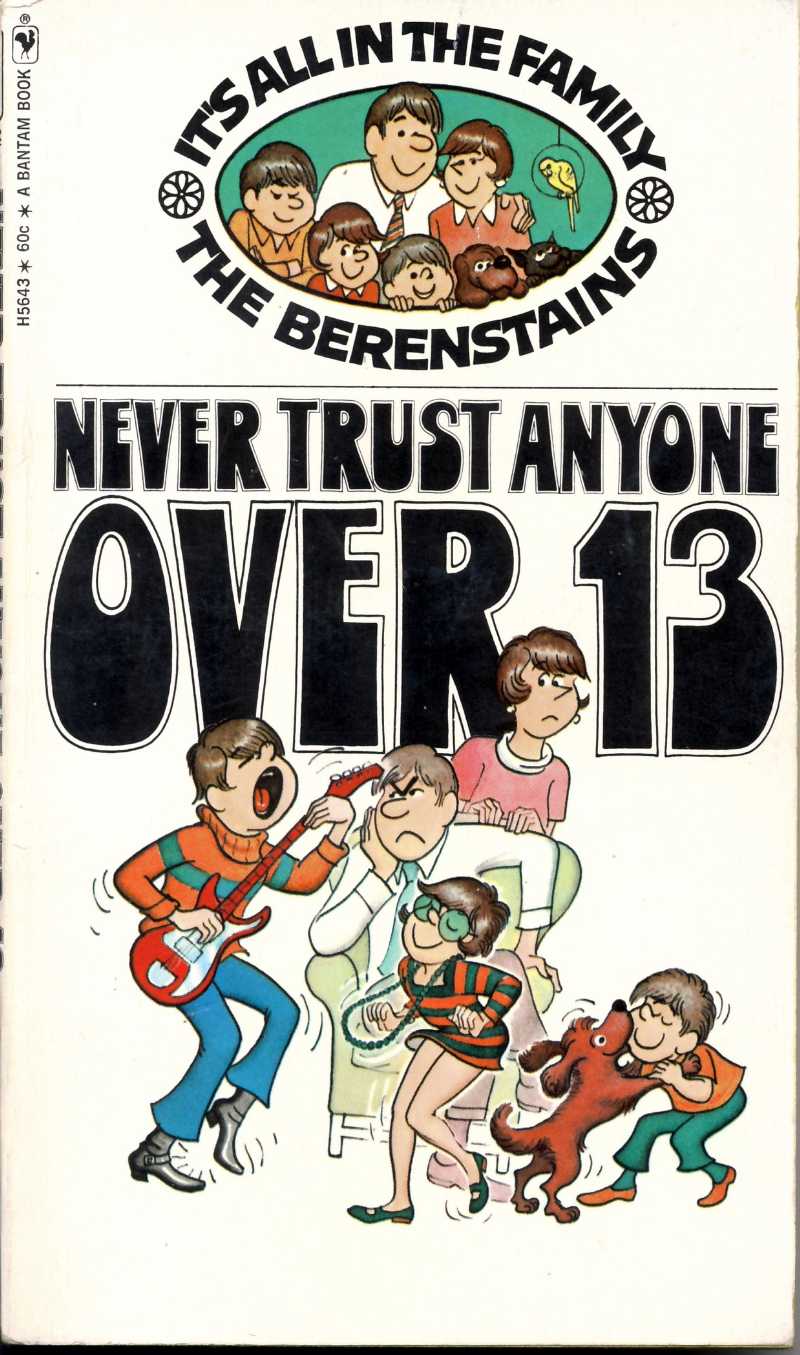
Berenstains, Berenstains… Wait a minute, Isn’t that?
Yes. Yes it is. If you were a kid in the closing decades of the 20th Century (especially the 1980s or ’90s), or raised kids during that time, then you probably have encountered the Berenstain Bears cartoon books by Stanley and Janice Berenstain. The husband-and-wife team had a long and productive run—the Berenstain Bears reached the 50th anniversary milestone in 2012.
But before the Berenstains turned almost all of their efforts toward producing gently humorous books about anthropomorphic ursines, they had another single-panel cartoon strip called It’s All In The Family that appeared in McCall’s and Good Housekeeping magazines.
The strip spawned several paperback collections, including this gem, Never Trust Anyone Over 13, from 1970. Imagining myself a future comic artist, I was a voracious reader and collector of all forms of comics back then, from Marvel superheroes to Charlie Brown compilations, whatever I could find. This is one that I’ve kept all these years. It’s a part of the Berenstain world that seems to have fallen through the cracks. I haunt a lot of used bookstores but have never seen another copy.
As with the bears, it’s gentle humor that examines the foibles of family life. It’s also an example of very skillful cartooning that manages to develop characters and tell a funny story all within the confines of a single panel.
Of course, it’s a product of its time, which makes it a fun period piece to read today. There are lots of jokes about long hair, teenage rock bands, and the ‘tween girl’s swooning over “Herbert’s Hoozits.”
And yes, the characters look like Berenstain Bears turned into people (or vice versa).
But it holds up well. And not to put too much of a financial emphasis on it, but the whole sprawling Berenstains empire is a reminder to writers how one well-developed property can have an extremely long and lucrative life. Especially if cute bears are involved.
Robert Silverberg: When the Blue Shift Comes
Robert Silverberg is one of my favorite authors. He’s one of the few writers whose work I actively collect—I’ve got crumbling, decades-old paperbacks, 1st edition hardcovers, book club editions (which were often the only hardback versions ever made of some of his works) and trade paperbacks.
As a reader, I’ve loved the range of his stories, from tales set billions of years in the future to convincing SF tales set in contemporary times. As a writer, I’ve admired his style and his skill, and his ability to write in so many genres, under so many pen names, for so many decades. He makes it seem so effortless, and his best works, such as Dying Inside, haunt your thoughts long after you’ve finished the book.
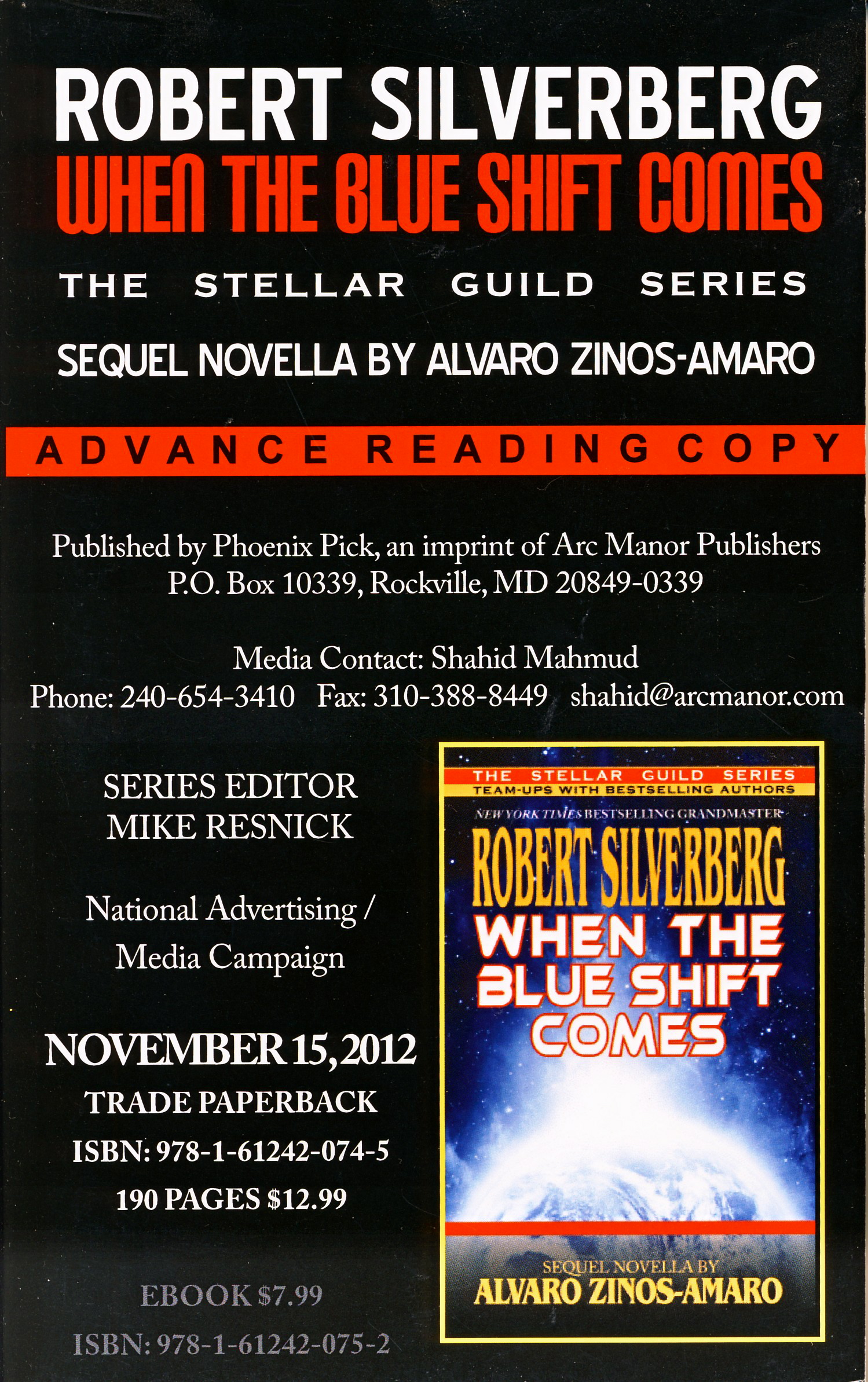
But for all my Silverberg collecting, I’d never secured an Advanced Reading Copy until recently (An ARC is an early edition sent to reviewers prior to regular publication.) I picked up this copy of When the Blue Shift Comes at ArmadilloCon in Austin this summer, and not only is it a unique addition to my collection, but it represents a new concept in fiction publishing.
When the Blue Shift Comes is part of The Stellar Guild Series by Phoenix Pick, in which famous authors are teamed up with up-and-coming writers. Sometimes the well-known writer selects a protege with whom to collaborate, sometimes the publisher suggests a candidate, but you end up with a tale begun by the famous author and completed by the newcomer. Besides Silverberg, some of the other authors in the series include Larry Niven, Harry Turtledove and Mercedes Lackey, so the publisher has some heavy-hitters lined up.
When the Blue Shift Comes is Silverberg without restraints, a tale set in a distant future where humans hop between galaxies as easily as we drive to the next town. How far in the future? Well, it’s the Year 777 of Cycle 888 of the 1111th Encompassment of the Ninth Mandala which, if you check your calendar, is pretty far out there. Earth is populated by immortals, at least until a universe-threatening anomaly is discovered and sets the story in motion. Silverberg wrote the first half of this novella and then handed it off to Alvaro Zinos-Amaro, who did a fine job completing the story. It could not have been an easy task—Silverberg employed a very unique voice, almost as if a flighty angel were telling the tale, but Zinos-Amaro picks it up seamlessly. In addition, Silverberg set a very large stage that must have been a mind-bending challenge to finish. Hey, how would you like to have to take a half-finished tale that moves us to the brink of the very end of the universe itself, and bring it to completion? Nicely done, Alvaro.
When the Blue Shift Comes will be released in November in trade paperback and e-book.
Long-Lost Paperbacks, No. 2
John Jakes is a name anyone who ever walked through a bookstore in the 1970s and ’80s will recognize. He became famous (and rich) for his North and South civil war trilogy, and the Kent Family Chronicles, a series of historical fiction novels set during the American Revolution and published in the years before and after the Bicentennial in 1976.
But long before he became a New York Times bestseller, he was a prolific writer in multiple genres, including science fiction and fantasy.
One example is this paperback edition of Witch of the Dark Gate, which hails from 1972. I bought this book new at a shopping mall bookstore, as I recall. I’d never heard of Jakes at that point and, I’ll admit, I bought the book in large part because of the Frank Frazetta cover. Even then I was a Frazetta fan, thanks to his work on the Conan the Barbarian books that were being reissued at that time. Can a cover alone make a sale? It sure made me plunk down my 95 cents for this one. Lesson learned. 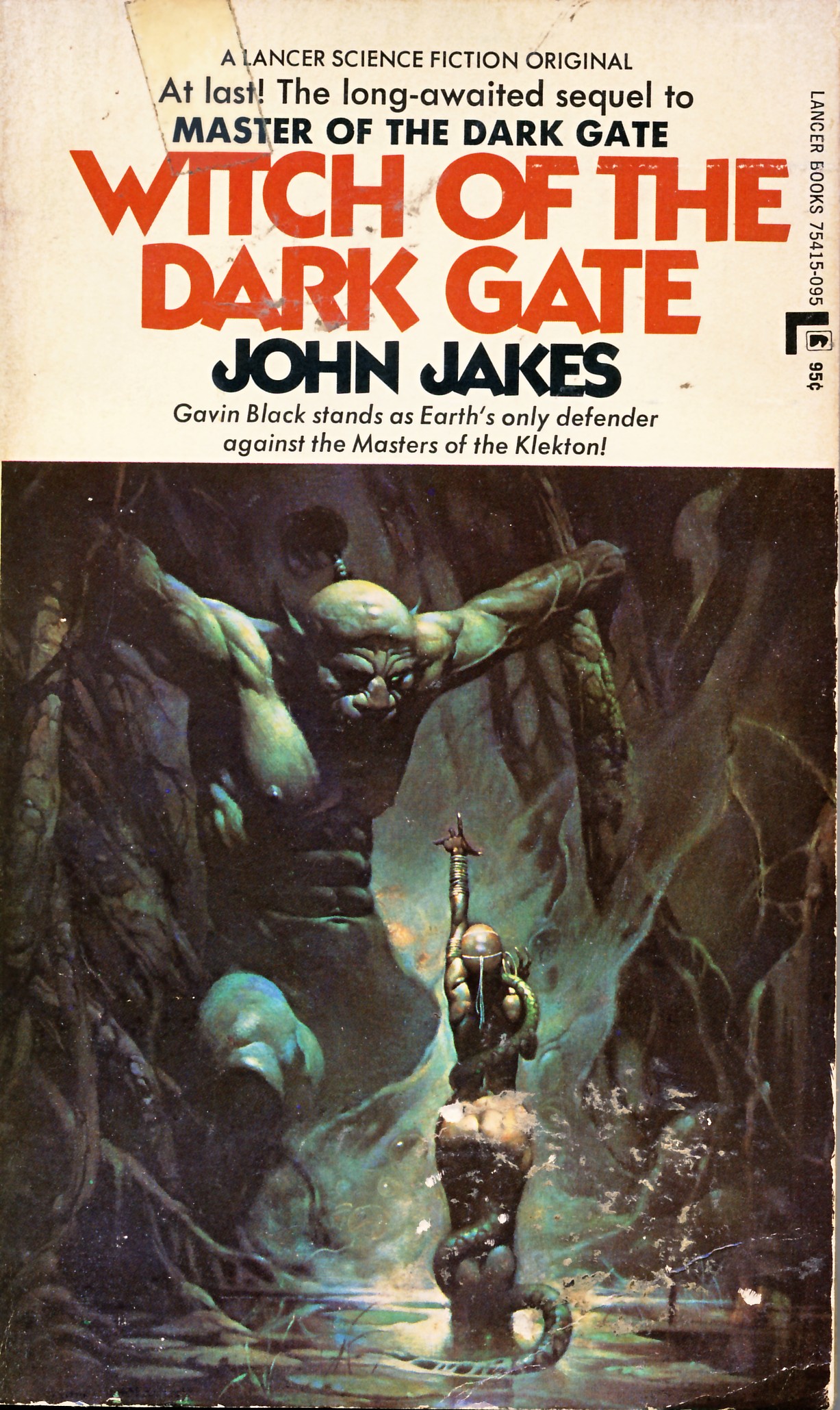
I recall liking the story, although I think I somehow missed the part about this being a sequel, and was slightly frustrated that I hadn’t read the first book in the series before this one. Whatever its merits, it didn’t make me seek out other Jakes books. But I do recall performing a classic double-take years later when I first saw his mainstream historical novels piled high at the front of the bookstore on the best-seller display. I wonder what all those North and South fans would have thought of this?
John Jakes is certainly not forgotten, but many of his earlier science fiction and fantasy works have drifted into obscurity. I look forward to giving this one the second chance it deserves, even if it is 40 years later.
Long-Lost Paperbacks, No. 1
Hard as it is to believe, the mass-market paperback book is on its way out. Of course, the rapidly evolving publishing industry is changing so fast that it’s risky trying to make predictions, but the short-term outlook for books seems to be narrowing down to three categories: ebooks; high-end hardcovers; and larger-format trade paperbacks. We’ll still see traditional mass-market paperbacks for a while yet, but the economics of the new publishing era work against them.
Speaking as someone who has embraced the ebook revolution whole-heartedly, it will still be hard watching cheap and portable paperbacks disappear from book shelves. For millions of readers, the mass-market paperback was the primary vehicle for recreational reading. In the hope that these artifacts of 20th Century popular literature aren’t forgotten, this is the first in an occasional series remembering some of the more obscure and forgotten titles. Although printed in the hundreds of millions, paperbacks weren’t usually intended for the long haul. The pages yellowed quickly, the spines developed creases after even careful reading, and the glue released its grip on the pages with frustrating frequency. They didn’t share display space on the living-room bookshelf with the famous-author hardcovers and the family bible. They were typically stuffed in backpacks or jacket pockets and casually traded among friends. For a bookmark, you folded a corner of the page. Most of them haven’t survived to the present day.

With all that in mind, first up is a 1964 Ace edition of Almuric by Robert E. Howard. The creator of Conan the Barbarian is justly famous now, of course, but between his prolific pulp magazine career in the 1930s and, oh, about the early 1970s, Howard fell into relative obscurity. Much of his work was not in print. I vividly remember haunting used bookstores in the early 1970s trying to dig up old Howard paperbacks and it was no easy task. Later in the decade, thanks in no small part to the success of the Conan the Barbarian Marvel comic books, Howard’s work enjoyed a second round of fame, and everything he wrote was released in a dizzying array of paperbacks (most of which I still have).
But this 40-cent, 160-page Almuric title predates that revival. It is one of the smallest and cheapest paperback formats, intended for those crowded spinning book racks like you’d find at the drugstore. In later years Howard’s books were paired with amazing Frank Frazetta covers, but this edition’s simple illustration didn’t even earn a cover credit for the artist.
The Almuric story was originally serialized in Weird Tales magazine in the 1930s. It is reportedly Howard’s only “interplanetary” tale, with the hero, Esau Cairn, blasted across space to the demon-haunted planet Almuric. If you’ve ever read Howard, you can imagine what comes next. Robert E. Howard’s legacy is now secure, but it was cheap and accessible paperbacks like this that kept the flame burning in those long years before he was rediscovered.
 Rocket Cars to Mars