
Amazon’s Kindle Matchbook promotion just went live, and I’ve entered my novels in the  program. If you haven’t heard, what this means is that if you purchase any of my books in paperback form through Amazon, you can get the e-book for only 99 cents extra. The program is retroactive, so if you’ve ever bought any of my paper novels through Amazon, you can get the e-book for 99 cents. Nice way to buy a paper copy for a gift and get the e-book for yourself for a buck extra. Each book page on Amazon has the Matchbook link, so it’s easy to do. To check it out, just click on the book covers in the sidebar.
Monthly Archives: October 2013
Author Interview: Eric Tozzi
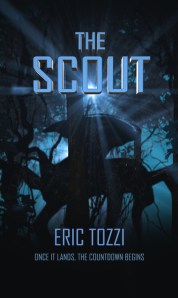
Eric Tozzi is that rarity in science-fiction—someone who has worked closely with real-world space programs and then used those experiences to build his own worlds of the fantastic. He was a documentary producer and editor at Jet Propulsion Laboratory, and has also produced a variety of web video series. He directed the award-winning independent film Kaleidoscope, based on the Ray Bradbury short story. Tozzi just released his first science-fiction novel, The Scout, so it seemed like the perfect time to talk with the writer/director/producer.
You just released your novel The Scout. Give us the elevator pitch: What’s it about?
ET: The Scout is an alien invasion thriller with a science-based foundation. But really it’s a story about the inevitability of change. In the book it plays out in two arenas: the family and the world. The hero, Jack McAllister, is confronted by the sudden death of his estranged father, and left to care for his Alzheimer’s-stricken mother. Those things carry huge implications for his personal life. But when a robotic geochemist—an alien scout—lands in the forest nearby to conduct an environmental survey, he’s drawn into the realization that things are about to change catastrophically for the entire planet. Jack soon discovers he might be able to change the course of world events before it’s too late, but remains powerless to change the fate of his own parents.
I should mention that I wrote the loss of family component from a very personal perspective. Both my parents passed away in 2011 as I began writing this book. There are numerous moments in the story that are very close to the real thing.
You used to work for JPL documenting the efforts behind the Mars Curiosity Rover and Twin MER missions, among other assignments. How did those experiences influence your work?
ET: Working at JPL had a huge impact on how I saw space exploration. Most profoundly, I realized that it is an incredibly hard, if not an impossible feat. There are just so many things that can go wrong on a mission. Most people have no idea the millions of points at which a spacecraft can fail. It’s really a miracle that we’ve had so much success in deep space with, say, Voyager and Cassini, and on the surface of Mars with Viking, Pathfinder, MER Rovers, Phoenix and Curiosity. The systems on these vehicles are complex, and the conditions in which they’re placed are incredibly hazardous. It seems a recipe for almost certain failure.
It’s when you watch the teams working together: the engineers, planetary scientists—all of them—that you realize what kind of patience and dedication it takes to pull off a mission like the Curiosity Mars Rover. They think and plan in terms of decades, not years. They spend all that time trying to engineer out any possible problem. And just when they’ve solved one, a hundred more materialize from out of nowhere. It’s an ongoing challenge.
In fact, I recommend, for those who are interested, looking at some of the documentaries I shot and produced, titled, “The Challenges of Getting To Mars,” available at the official JPL/NASA website.
In terms of how this all influenced me writing this book, I took a lot of what I learned about the entry, descent, and landing of a vehicle on another planet and reverse-engineered it for the story. I thought, if a scout mission were to land on Earth, how would it get here, and what would it be looking for?
You’ve been right there inside the heart of NASA and have now moved on to science-fiction, which has clearly been a dream of yours for some time. Who were your science-fiction influences?
ET: Ray Bradbury was a huge influence. I remember reading Martian Chronicles as a kid, and even seeing the old TV Miniseries version of it back in the ’70s. I was also a huge Star Trek and Lost In Space fan when I was a little kid. The premise of exploring the heavens and discovering other worlds with all kinds of strange life…I loved that! I also loved all the gadgets: phasers, communicators, tricorders, giant viewer screens and warp drives. As a kid, one word: awesome.
Your film Kaleidoscope, based on Ray Bradbury’s short story, has won a pile of awards on the independent film circuit and was shown at Worldcon this year. How did that project come to be, and what did Bradbury think of it?
ET: The film came together when the producer/star, Brett Stimely, approached me about doing some “actor’s scenes” from the short story to showcase himself in the part of Hollis, the main character. It wasn’t long before “actor’s scenes” became the production of the whole story as a film, with photo-real visual effects produced by some very talented artists, some of whom worked at Digital Domain, Disney and DreamWorks.
A mentor of mine, TV producer, writer, and novelist Marc Scott Zicree (The Twilight Zone Companion), helped put us together with Ray personally, so we could shoot the film with his blessing on it.
We screened the film for Ray at his home in early 2012, just a few months before he passed away. Ray truly loved Kaleidoscope, and told us, “It’s beautiful…it made my life!”
You’ve directed films and web series, and now written a novel. How does structuring a story for film differ from constructing a story for the page? Which is more difficult?
ET: They both have their challenges, but I found an incredible amount of liberty writing a novel as opposed to writing a screenplay. Screenplays demand a very precise writing style and structure. If you want a shot at getting your spec script considered at an agency or production company, and you’re a new writer, you have to play by the rules, period. There are typically 60 story beats in any script, major and minor act breaks, a strong mid-point all launched by an inciting incident. And your page count has to be within a certain margin (usually 90 to 120 pages max). You can’t turn in a 200 page screenplay and expect a reader at an agency or production company to give you the time of day. Unless you happen to be James Cameron.
Novels and screenplays can be equally challenging. But at the heart of both should be a great story with great characters and some emotional truth powering it all. If you know your end from the beginning, if you can draw people into the moment with the characters, and if you make sure you’re not leaving gaping plot-holes or loose ends…you’ve got something.
What’s your next project?
ET: Like most people, I have several pots on the stove. On the book front, I’ve begun working on a new novel with the working title, “The Zoo.” It’s another science fiction thriller, but this one takes place on an alien world…a heavy planet. Lots of action planned for this one. I may also be pulling a screenplay I wrote years ago, “Field Of Gods,” off the shelf and novelizing it.
There are a couple of low-budget sci-fi features I hope to be shooting next year. I also have a female-driven superhero web-series in development over at Endemol, and I’m excited to see that one get funded and take off soon!
For The Scout, I’m planning on producing an audiobook version through ACX Amazon, and a print version too. Most of all, I really hope people enjoy The Scout, and find it to be an exciting and interesting story that keeps them hooked and entertained.
Long Lost Paperbacks No. 5
Armageddon 2419 A.D. is one of the most influential works of science-fiction ever  published.
Oh, stop sputtering. What’s that? How can it be influential when you’ve never heard of it? When it has won no Hugo or Nebula awards? Well, perhaps you’ve heard of the main character—Buck Rogers. This book contains the story that started it all, the original Buck Rogers tale.
Armageddon 2419 A.D. by Philip Francis Nowlan was first published as a novella in Amazing Stories in 1928. It spawned a huge entertainment empire, consisting of Buck Rogers comic strips, radio programs, motion picture serials, and TV shows. Today they would call that a “franchise.” Buck Rogers became a pop culture hero, a household name, in a way that most of the greatest science-fiction books never matched.
Still, I honestly can’t even remember what initially attracted me to this book. Probably the cool cover. The whole Buck Rogers cultural phenomenon was well before my time. It was another generation’s entertainment. When I started reading science-fiction in the 1970s, Buck Rogers already had a bit of a campy air about it. There was a TV show revival in the late 1970s, but I don’t recall watching it.
When a concept has been through so many iterations, it can be hard to separate the quality from the crap, and that probably also colored my opinion. But once I started reading the original source material, I was sold. Armageddon 2419 A.D. is one of those books I used to re-read on an annual basis. I have a friend who felt the same way and he borrowed it several times. Of course, as science-fiction it was dated even in the 1970s, let alone now. But it’s a solid pulp adventure tale. “Anthony” Rogers, a WWI vet, was working for the American Radioactive Gas Corporation, investigating a strange gas in a Pennsylvania coal mine. There’s a cave-in, and the gas holds him in a state of suspended animation until he wakes up in the year 2419. Much adventure ensues fighting the Airlords of Han.
The original two novellas from Amazing Stories were excavated and published together in paperback form by Ace in 1962. Pictured is the third Ace printing from 1972, which is the one I plucked from the science-fiction shelf at my local bookstore. It has been read so many times it is beginning to feel a bit fragile. Fortunately, in our digital age books never have to die, and you can get Armageddon 2419 A.D. in e-book format for free through Amazon. Buck would appreciate that.
In the Mail
Thanks to all 574 of you who entered the Goodreads giveaway for a shot at winning one of the two signed copies of Follow The Chupacabra. The books went in the mail today.
 Rocket Cars to Mars